
Outbound works when one system owns the whole journey
Your stack loses the thread every time a rented tool hands work to another rented tool.
Workloom owns discovery, contact data, signals, infrastructure, outreach and voice in one system. That means a record can move from an unknown company to a contact your rep can call without crossing a vendor boundary. The state survives because the same system creates, enriches, routes and acts on it.
What does Workloom's all-in-one outbound system include?
Workloom is an outbound system that owns discovery, contact data, signals, infrastructure, outreach and voice in one system. It provisions and holds domains, mailboxes and phone numbers, and carries records from unknown companies to callable contacts without vendor handoffs. Five channels share one prospect thread: email, phone, LinkedIn, WhatsApp and Telegram.
One system, six owned layers
Each layer does a different job, but none of them has to surrender the record to another company.
Discovery finds the companies worth working. Contact data turns those companies into usable people and account records. Signals add the events and conditions that tell the system what deserves attention. The first three layers are connected by design, so a discovered account does not become a dead export waiting for someone to clean it, upload it and explain where it came from. See how the front half works in discovery and contact data.
Infrastructure is the part most stacks hide until it fails. Workloom provisions and holds the domains, mailboxes and phone numbers used for outbound. They are not rented from a pool. Outreach then coordinates email, phone, LinkedIn, WhatsApp and Telegram around one thread per prospect. That thread is the working record, not a collection of disconnected activity logs. The mechanics are laid out in infrastructure and outreach.
Voice gives the rep a callable path through the work. A contact does not stop at a name, an email address or a task in a queue. The system carries the record into voice, while signals determine what changed and voice gives the rep the next conversation to act on. The final layer is AI, where it helps operate across the owned system instead of pretending a separate agent can repair broken inputs.
Drag the diagram to see the rest
What breaks when every step is rented
The problem is not having several tools. It is asking each tool to preserve context it did not create.
A rented stack usually starts with a data source, moves into a sending tool, then crosses into a sequencing layer, a phone system and a CRM. Each handoff creates a new version of the record. Fields get mapped. Statuses get translated. Activity arrives late or not at all. By the time a rep sees the contact, the reason it entered the workflow may be missing. The stack still looks connected in a diagram. The state is not.
Sending infrastructure exposes the same fault from another angle. If domains, mailboxes and numbers sit outside the system running outreach, the sender has no single place to understand what was provisioned, what is active and which prospect thread belongs to which channel. Workloom holds that infrastructure itself. That does not make a bad message good. It means the sending layer and the work layer can share the same record instead of negotiating through exports.
This is why adding another connector rarely fixes the root problem. A connector moves fields after the fact. It does not preserve every decision, signal or channel event across the journey. Workloom has zero vendor handoffs between the steps. That is the whole reason state survives from discovery through contact data, signals, infrastructure, outreach and voice. If a rented stack keeps making your reps reconstruct context, inspect the boundary, not the dashboard.
Drag the diagram to see the rest
How a record moves end to end
A company becomes a callable contact through a defined chain of processing, not one magical enrichment step.
The journey starts with a company nobody has heard of and ends with a contact your rep can call. Sixty-two processing stages stand between those two points. Discovery identifies the account. Contact data shapes the people and fields attached to it. Signals add the conditions that affect timing and priority. Each stage carries the record forward instead of asking a new tool to infer what happened before.
Behind that path are 574 operations, 186 services and 94 record types, spread across 80 screens in the product. Those figures describe the working surface of the system, not a claim that complexity is useful by itself. The point is traceability. A record can be handled by the right operation, stored in the right form and shown where the team needs it. That gives operators something concrete to inspect when a record stalls.
The outside world still has a place. Twenty-nine outside systems connect in, covering calendars, chat and CRM. Google Calendar, Outlook Calendar and Calendly can sit alongside Slack, HubSpot and Salesforce. LinkedIn, WhatsApp and Telegram can carry prospect activity into the same thread. The boundary is clear: your systems connect in, but the core journey does not depend on passing ownership from one vendor to the next.
Drag the diagram to see the rest
What changes for the rep
The rep gets a live work context instead of a pile of tools that each remember a different version of the account.
A rep starts with the account, contact, signals and active conversation in one place. The five outreach channels share one thread per prospect: email, phone, LinkedIn, WhatsApp and Telegram. That matters when a prospect answers on one channel after activity on another. The rep does not need to hunt through separate timelines to work out what has already happened or which channel owns the next move.
The rep also gets a clearer relationship with infrastructure. Domains, mailboxes and phone numbers are provisioned and held by Workloom, not rented from a pool. That ownership sits underneath the work rather than appearing as another vendor console to monitor. When a rep moves from written outreach to a call, voice is part of the same system. The contact is already there, with the context that made the call worth making.
None of this removes judgment from the rep. It removes the administrative archaeology. The rep can inspect the record, read the signals, choose the channel and call when the path points there. Operators can then see where a record is in the 62-stage journey and adjust the right layer instead of blaming the last tool in line. That is the practical difference between owning the stack and assembling it from rented parts.
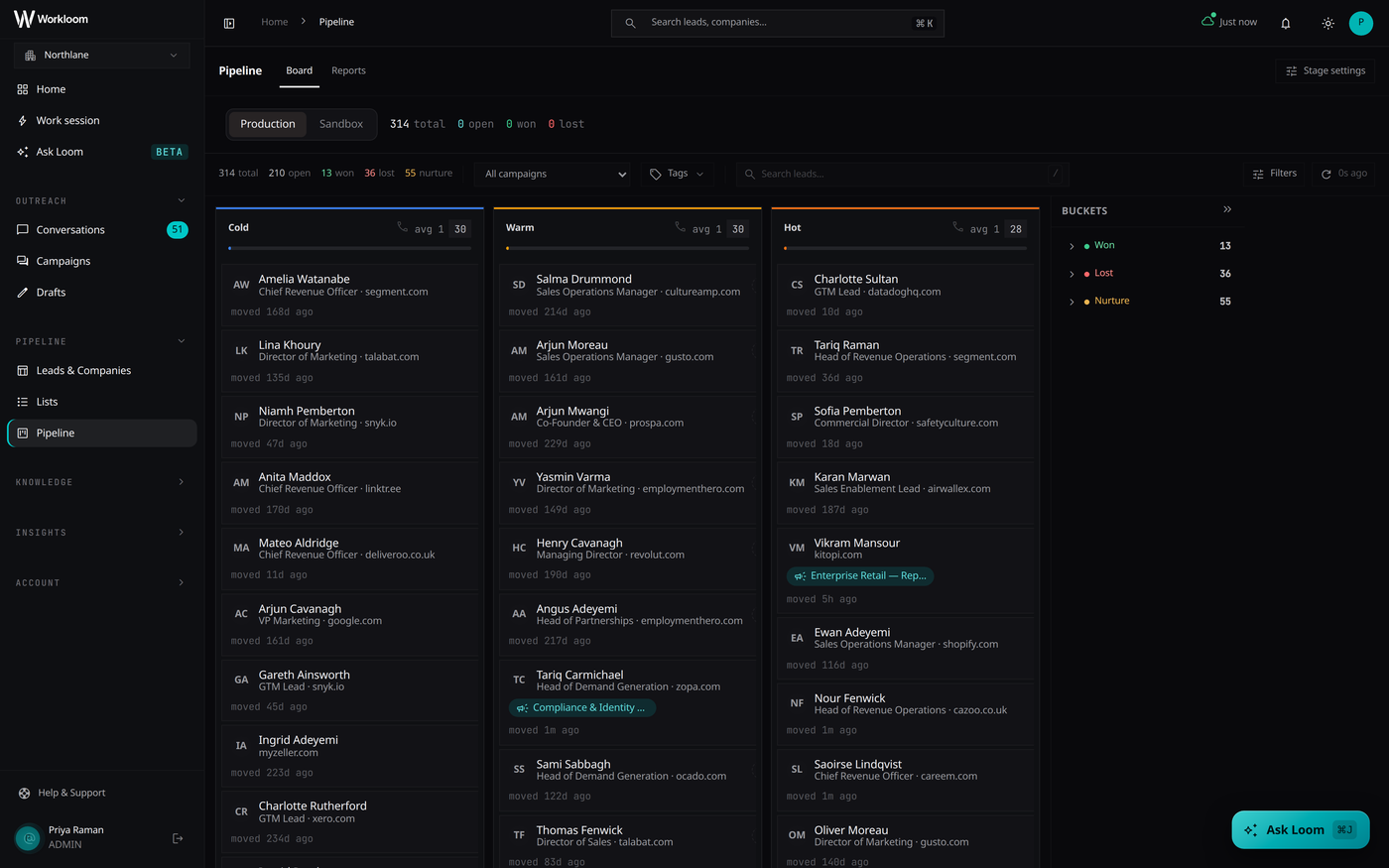
Real product. Names, email addresses, phone numbers and company details have been changed for privacy.
Drag the diagram to see the rest
Drag the diagram to see the rest
What does Workloom own?
Workloom owns six layers: discovery, contact data, signals, infrastructure, outreach and voice. It also provisions and holds the domains, mailboxes and phone numbers used by the system.
How many channels share a prospect thread?
Five channels share one thread per prospect: email, phone, LinkedIn, WhatsApp and Telegram.
Can our existing systems connect?
Yes. Twenty-nine outside systems connect in, including Google Calendar, Outlook Calendar, Calendly, Slack, HubSpot, Salesforce, LinkedIn, WhatsApp and Telegram.
Why do vendor handoffs matter?
A handoff forces one system to pass context to another and creates a new version of the record. Workloom has zero vendor handoffs between the steps, so state survives the journey.
The other owned layers.
See the system in motion
Walk the six layers, inspect the record path and see where your current stack loses state.